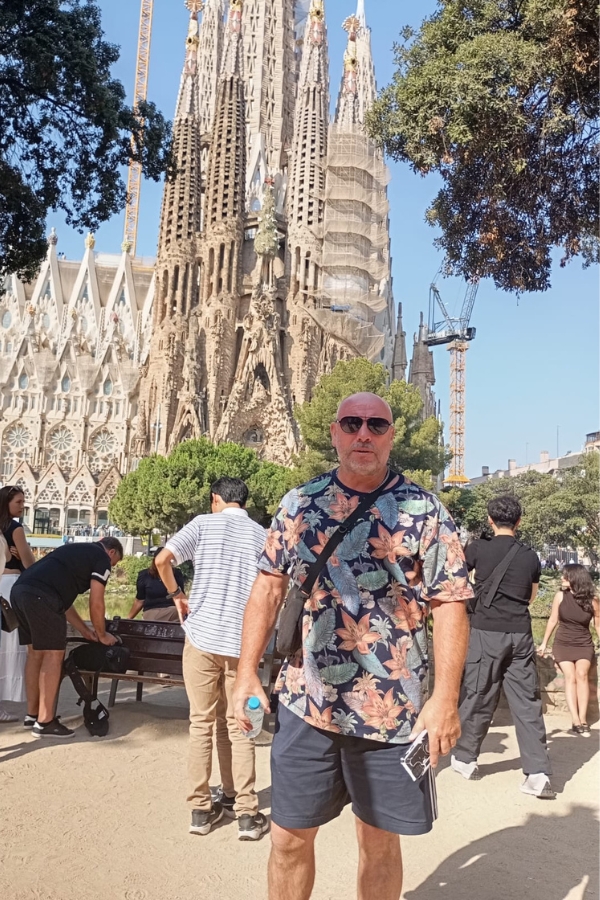
The Sagrada Familia isn’t just Barcelona’s most famous landmark—it’s one of the world’s most extraordinary architectural achievements. Antoni Gaudí’s unfinished masterpiece has been under construction for over 140 years, and visiting it remains one of Europe’s most profound travel experiences and as such is at the top of most peoples’ things to do in Barcelona checklist.
This comprehensive Sagrada Familia guide covers everything you need to know: how to buy tickets, what to see, the best times to visit, and how to make the most of your experience at this UNESCO World Heritage Site.
What Makes the Sagrada Familia So Special?
Before diving into practical details, it’s worth understanding why this building captivates millions of visitors annually.
The Sagrada Familia represents architect Antoni Gaudí‘s life work—a basilica he knew he wouldn’t live to see completed. From 1883 until his death in 1926, Gaudí transformed what began as a conventional neo-Gothic church into something revolutionary: a building where nature, mathematics, faith, and art converge in unprecedented ways.
Unlike traditional cathedrals with their straight lines and right angles, the Sagrada Familia draws inspiration from natural forms. Columns branch like trees, geometric patterns echo natural spirals and honeycombs, and light filters through stained glass like sunlight through a forest canopy. Gaudí believed nature was God’s creation and therefore the perfect architectural teacher.
The basilica remains under construction today, funded entirely by visitor admissions and private donations. Your ticket directly contributes to completing Gaudí’s 140-year-old vision, making you a patron rather than just a tourist.
Sagrada Familia Tickets: How to Book and What to Choose
Book Online in Advance—Always
The Sagrada Familia sells out weeks in advance during peak season (April-October). Don’t assume you can buy tickets at the door. Book through the official website (sagradafamilia.org) at least 2-4 weeks ahead for summer visits, or 1-2 weeks for off-season.
Beware of third-party ticket sellers charging inflated prices. The official website is your best option for legitimate tickets at standard prices.
**Personal Experience: Please take what I have written above as absolute gospel. I visited in June 2025 and hadn’t booked a ticket for entry into the Basilica and was unable to get inside. I was surprised to find out that the next available ticket was six weeks later!
Ticket Types and Prices (2026)
Several ticket options are available, each offering different experiences:
- Basic Admission (€26): Entry to the basilica and museum only. This budget option allows you to explore the interior and underground museum but doesn’t include the audio guide or tower access.
- Basilica with Audio Guide (€32): The best value for most visitors. Includes basilica entry, museum access, and the essential audio guide available in 16 languages via smartphone app. The audio guide is highly recommended—the basilica’s symbolism is complex, and you’ll miss significant meaning without explanation.
- Basilica with Audio Guide and Tower (€42): Adds access to one of the towers (you choose between Nativity or Passion façade towers). This provides spectacular city views and close-up encounters with architectural details, but requires descending approximately 400 steps via narrow spiral staircases.
- Guided Tour (€32-€35): Live guide instead of audio guide. Small group tours (15-20 people) offer expert insights and the ability to ask questions. Guided tours typically last 90 minutes.
- Gaudí House Museum Combo (€32): Combines Sagrada Familia admission with entry to Casa Museu Gaudí in Park Güell, where the architect lived from 1906-1925.
Which Tower Should You Choose?
If you’re adding tower access, you must choose between the Nativity Façade towers or Passion Façade towers when booking.
- Nativity Façade Towers: Completed during Gaudí’s lifetime, these feature more organic, decorative details. Views face the Mediterranean and central Barcelona. The spiral staircases feel more enclosed and medieval.
- Passion Façade Towers: These offer views toward Montjuïc hill and western Barcelona. The interior bridges connecting towers provide dramatic photo opportunities. Many visitors prefer these for their more open feeling.
Both options include elevator access up but require descending via narrow spiral stairs—not recommended for those with claustrophobia, mobility issues, or fear of heights. Children under 6 cannot access towers for safety reasons.
Important Booking Details
- Choose your entry time carefully—you cannot change it easily after booking
- Tickets are non-refundable
- You must arrive at your designated time (arriving late may mean waiting for the next entry window)
- Bring government-issued ID matching your ticket name
- Download the audio guide app before your visit to save time
When to Visit: Timing Your Sagrada Familia Experience
The Sagrada Familia offers different experiences depending on when you visit—both time of day and season dramatically affect your experience.
Best Time of Day
The basilica’s stained glass creates stunning light effects that change throughout the day.
- Morning (9:00-11:00 AM): The eastern Nativity Façade windows feature cool colors (blues, greens, purples). Morning sunlight streaming through these windows creates a serene, almost underwater atmosphere. This is also when crowds are smallest—the first entry slot (9:00 AM) offers the best combination of beautiful light and manageable crowds.
- Afternoon (4:00-6:00 PM): The western Passion Façade windows feature warm colors (reds, oranges, yellows). Late afternoon sunlight transforms the interior into a golden cathedral with warm hues dancing across white columns. This creates the most dramatic lighting for photography, though it’s a popular time with larger crowds.
- Midday: Direct overhead sunlight creates less dramatic lighting effects. This is also when tour groups peak, making the basilica most crowded.
Best Season
- Spring (April-May): Ideal weather, manageable crowds, and excellent lighting conditions. Barcelona’s spring brings warm days without summer’s oppressive heat.
- Fall (September-October): Similar advantages to spring—comfortable weather, smaller crowds than summer, and beautiful light. September is particularly pleasant.
- Summer (June-August): Peak tourist season means maximum crowds and heat. Book well in advance and visit early morning to avoid the worst crowds and heat. The basilica lacks air conditioning, relying on natural ventilation.
- Winter (November-March): Smallest crowds and lowest prices, but shorter days mean less dramatic interior lighting. The basilica is heated but can feel chilly. This is ideal for visitors who prioritize avoiding crowds over optimal lighting.
What You’ll See Inside: The Sagrada Familia Experience
The Façades: Three Acts of Christ’s Life
The Sagrada Familia features three grand façades, each telling part of the Christian story:
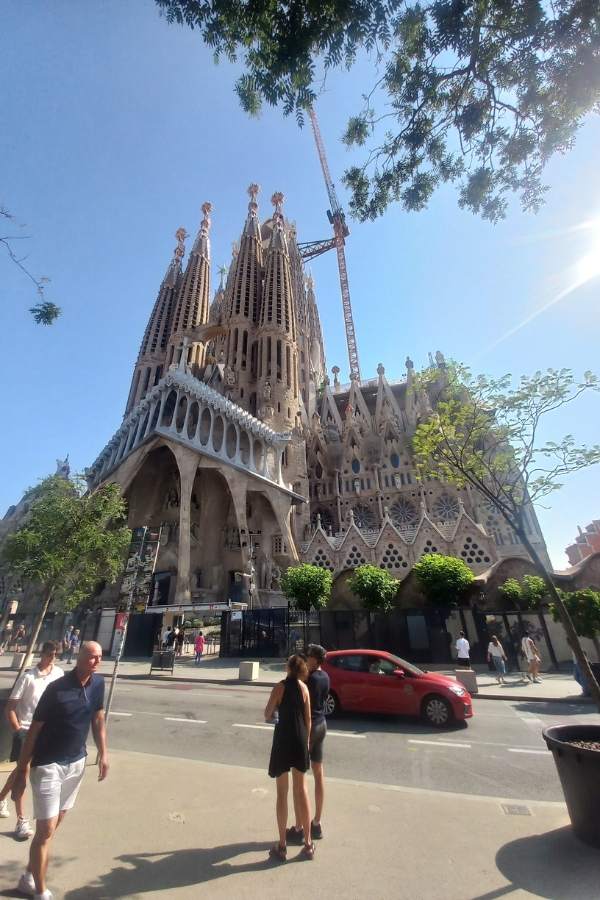
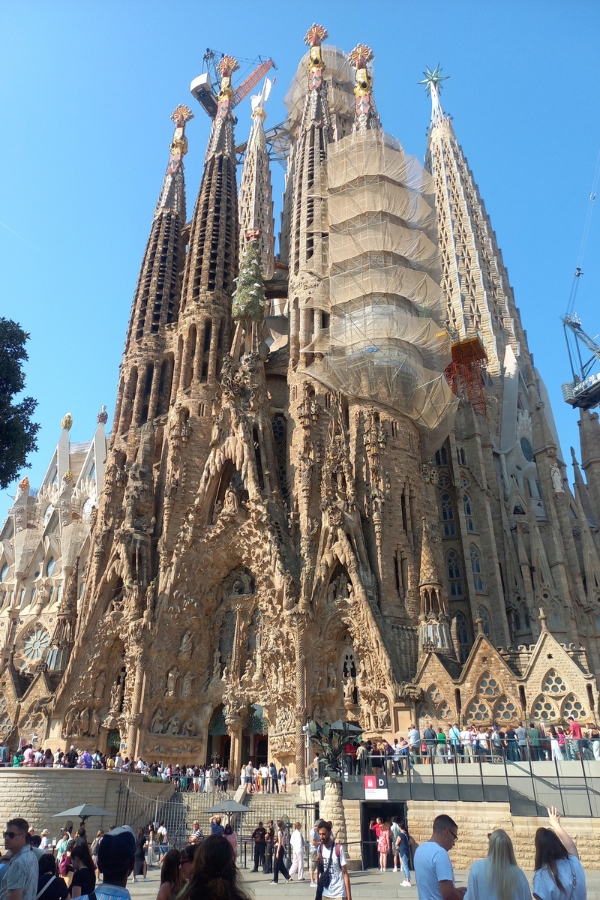
- Nativity Façade (East): Completed during Gaudí’s lifetime, this exuberant façade celebrates Christ’s birth. Every surface overflows with sculptures depicting the Holy Family, angels, animals, and plants. The style is organic and joyful, with natural forms and intricate details. Four towers rise above, dedicated to apostles Barnabas, Jude, Simon, and Matthew.
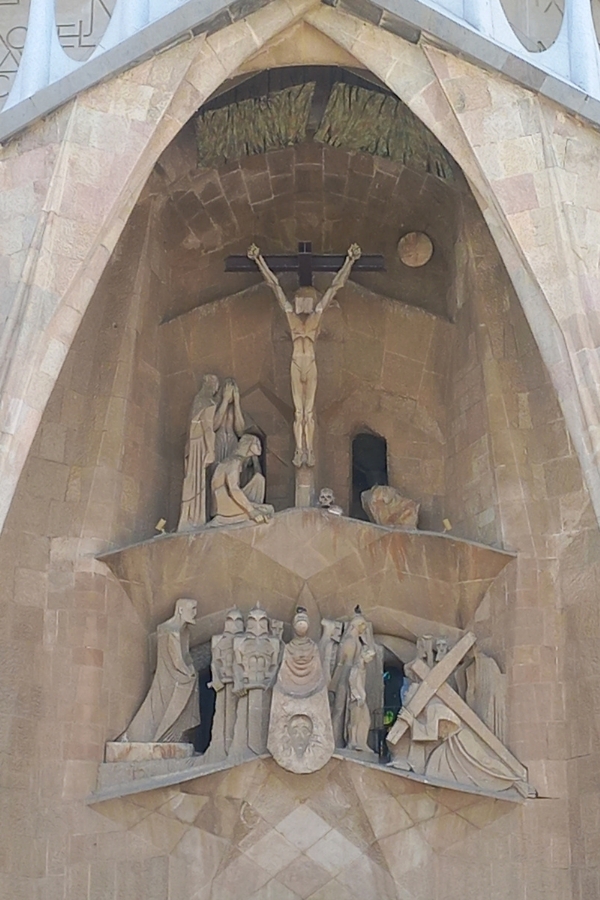
- Passion Façade (West): Designed by Gaudí but completed after his death by sculptor Josep Maria Subirachs, this stark façade depicts Christ’s suffering and crucifixion. The angular, skeletal sculptures and bare stone create a dramatic contrast with the Nativity Façade’s abundance. This controversial modern interpretation divides opinion—some find it powerful, others feel it clashes with Gaudí’s original vision.
- Glory Façade (South): Still under construction, this will be the main entrance, representing death, judgment, and glory. The most complex and largest façade will eventually feature depictions of heaven and hell, the seven deadly sins and seven virtues, and Christ’s resurrection.
The Interior: A Forest of Stone and Light
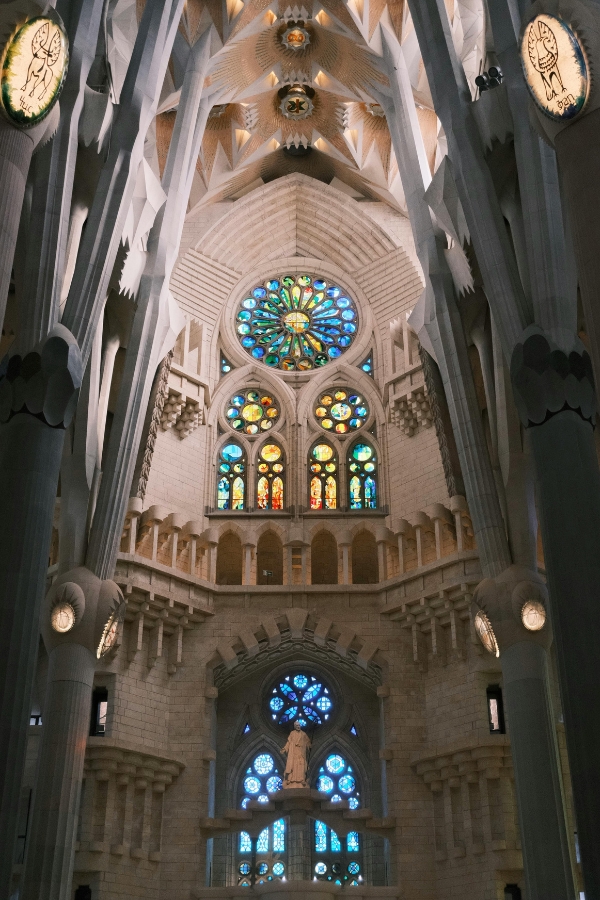
Stepping inside reveals the Sagrada Familia’s true genius. The interior resembles a stone forest—columns branch like trees, creating a canopy of geometric vaulting overhead. This isn’t mere metaphor; Gaudí studied tree structures to understand how natural forms distribute weight efficiently.
The columns use different stone types (basalt, granite, porphyry) chosen for their load-bearing requirements, with harder stones supporting greater weights. They lean at calculated angles, following natural force lines like tree trunks bending toward light.
The ceiling features hyperboloid and paraboloid shapes—ruled surfaces created with straight lines forming curved three-dimensional forms. This distributes weight efficiently while creating visual complexity that draws the eye upward.
But the interior’s most breathtaking feature is the light. Stained glass windows transform sunlight into a symphony of color. Cool blues and greens on the east transition to warm reds and oranges on the west, representing the journey from birth to sacrifice. The effect changes throughout the day as the sun moves—no two visits are identical.
The Towers: Ascending Toward Heaven
If you’ve booked tower access, prepare for one of Barcelona’s most memorable experiences. After an elevator ride up, you emerge onto narrow bridge passages connecting the towers. These walkways offer stunning views across Barcelona, from the Mediterranean to surrounding mountains.
The tower tops feature colorful trencadís mosaics—broken ceramic tiles creating organic patterns in brilliant colors. These Venetian glass and ceramic mosaics sparkle in sunlight, visible across the city.
The descent requires navigating approximately 400 spiral stone steps in tight quarters. Take your time—the stairs can be disorienting. This portion is not suitable for those with mobility issues, claustrophobia, or fear of heights.
The Museum and Crypt
The underground museum, included with admission, provides essential context about the basilica’s history and Gaudí’s creative process. Highlights include reconstructed models (the originals were destroyed in 1936 during the Spanish Civil War), Gaudí’s famous hanging chain models used to calculate arch curves, and the workshop where current construction continues.
The crypt, where construction began in 1882, features more traditional neo-Gothic architecture from before Gaudí’s involvement. Gaudí is buried here in a simple tomb—modest compared to the grandeur above. During masses, the crypt is closed to tourists as it serves as an active place of worship.
Practical Tips for Your Visit
Getting There
The Sagrada Familia is easily accessible via Barcelona’s excellent public transportation:
- Metro: Sagrada Familia station (Lines L2 and L5) deposits you directly at the basilica. From Plaça de Catalunya, take Line L2 toward Badalona Pompeu Fabra—just four stops, about 8 minutes.
- Bus: Multiple lines (19, 33, 34, 43, 44, 50, 51, B20/B24) stop nearby.
- Taxi/Uber: About €10-15 from the city center.
The basilica is located at Carrer de Mallorca, 401, in the Eixample district.
Dress Code
The Sagrada Familia is a consecrated Catholic basilica with strictly enforced dress code:
- Shoulders and knees must be covered
- No see-through clothing
- No tank tops or hats inside
- No beachwear
Visitors dressed inappropriately may be denied entry without refund. Bring a light scarf or shawl if wearing sleeveless clothing.
What to Bring
- Smartphone with headphones: For the audio guide app (download before arriving)
- Charged phone/camera: You’ll take many photos
- Government-issued ID: Must match your ticket name
- Small bag only: Bags larger than 45x35x20 cm aren’t permitted, with no storage facility available
Time Needed
Budget at least 90 minutes to 2 hours for the basilica interior and museum with audio guide. Add another 45-60 minutes if including tower access. Architecture enthusiasts and photographers should allow 3-4 hours.
Don’t schedule activities immediately after—you’ll likely want to linger, and rushing through would be tragic.
Photography Tips
Photography without flash or tripod is permitted inside. Tips for better photos:
- Use HDR mode on smartphones to balance bright windows and darker stone
- Photograph the ceiling by lying on the floor (many do this)
- Focus on details rather than capturing the entire space
- Visit during optimal lighting times (morning for blue light, afternoon for golden light)
- Be mindful of other visitors—don’t hog prime photo spots
Accessibility
The basilica offers wheelchair access via ramps and elevators to ground-floor areas including the main nave and museum. However, towers are not wheelchair accessible due to narrow spiral staircases.
Reduced-price tickets are available for visitors with disabilities and companions—book through the official website with appropriate documentation.
Understanding the Symbolism
The Sagrada Familia is a Bible written in stone, filled with symbolic meaning:
- The Structure: Eighteen towers represent the twelve apostles (four per façade), four evangelists (surrounding the main towers), the Virgin Mary (over the apse), and Jesus Christ (the central tower, still under construction and designed to reach 172.5 meters deliberately one meter shorter than Montjuïc hill, as Gaudí believed human creation shouldn’t surpass God’s natural works).
- Natural Elements: Gaudí incorporated over 100 plant species, each symbolically chosen. Palms represent victory and martyrdom, ivy represents fidelity and eternal life, wheat and grapes symbolize the Eucharist. Animals appear throughout—turtles at column bases represent the unchanging Church (one land turtle for earth, one sea turtle for sea), while chameleons represent spiritual transformation.
- Geometric Symbolism: Squares represent earth and material reality, circles represent heaven and divine perfection. The transition from square bases to circular towers represents spiritual ascent from earthly concerns to divine contemplation.
- Color Symbolism: Blue represents heaven and the Virgin Mary, green represents hope and new life, red represents Christ’s blood and sacrifice, yellow represents divine light, purple represents penitence and kingship.
- Numbers: Three (Trinity) appears in three façades and three portals per façade. Four (evangelists, cardinal directions) structures the tower arrangement. Twelve (apostles, tribes of Israel) determines the apostle towers. The magic square on the Passion Façade sums to 33 in all rows—Christ’s age at crucifixion.
Beyond the Basilica: Other Gaudí Sites
If the Sagrada Familia captures your imagination, Barcelona offers numerous other Gaudí masterworks worth exploring. For a broader overview of the city’s highlights, our comprehensive Barcelona travel guide covers everything from neighborhoods and culture to transport and cuisine.
- Park Güell: A fantastical park featuring organic forms, colorful mosaics, and the famous serpentine bench. The Monumental Zone requires tickets, but much of the park is freely accessible. Gaudí’s former residence is now a museum.
- Casa Batlló: A residential building (1904-1906) with an undulating façade, skeletal balconies, and dragon-scale roof. The interior features innovative solutions like a gradated blue light well. Augmented reality guides enhance the experience.
- Casa Milà (La Pedrera): Gaudí’s last private residential work (1906-1912) before dedicating himself entirely to the Sagrada Familia. The wavy stone façade and sculptural rooftop chimneys offer spectacular views.
- Casa Vicens: Gaudí’s first major commission (1883-1885), showing Moorish influences and his developing style.
- Palau Güell: An early work (1886-1890) demonstrating Gaudí’s ability to create extraordinary spaces within narrow urban lots.
Of course, Barcelona’s appeal extends far beyond Gaudí. From the buzzing La Boqueria market and the gothic quarter’s medieval streets to world-class beaches and a legendary food scene, there are countless things to do in Barcelona beyond architecture alone. The Sagrada Familia may be your primary reason for visiting, but the city will give you plenty of reasons to stay longer.
The Construction: Past, Present, and Future
Understanding the Sagrada Familia’s construction history deepens appreciation for its achievement.
- Gaudí’s Era (1883-1926): After taking over in 1883, Gaudí gradually transformed the design from neo-Gothic convention into something revolutionary. By the early 1900s, he worked almost exclusively on the basilica, eventually living on-site. He completed the crypt, apse, and Nativity Façade before his death in 1926 after being struck by a tram.
- The Civil War (1936-1939): Anarchists burned Gaudí’s workshop, destroying many original plans, models, and drawings. This catastrophic loss complicated all future construction—architects have painstakingly reconstructed his intentions from photographs, fragments, and descriptions.
- Modern Era (1950s-Present): Work resumed slowly after the war, accelerating dramatically in recent decades thanks to tourism revenue and modern technology. Computer-aided design, 3D modeling, and CNC stone-cutting machines have transformed construction speed while honoring Gaudí’s vision.
- Current Status (2026): The basilica is approximately 90-95% complete. The central Jesus tower continues rising toward its planned 172.5-meter height. The Glory Façade, Mary tower, and evangelist towers remain under construction, along with countless decorative details.
- Completion Timeline: The year 2026—the centenary of Gaudí’s death—was long targeted for completion, but COVID-19’s impact on tourism revenue and technical complexities have pushed completion into the late 2020s. However, the basilica is fully functional and substantially complete.
- Funding: Unlike most cathedrals, the Sagrada Familia has always been an “expiatory church”—funded entirely by private donations and visitor admissions. Your ticket directly supports completing Gaudí’s vision.
Visiting with Children
The Sagrada Familia can enchant children when approached thoughtfully:
- Young Children (0-5): The visual spectacle often captivates even toddlers. The colorful lights and vast space provide sensory stimulation. However, expect shorter attention spans. Children under 6 cannot access towers for safety reasons. Strollers are permitted though challenging in crowds.
- School-Age (6-12): Create scavenger hunts to increase engagement—finding specific animals, counting towers, identifying colors. The children’s audio guide (available in some languages) presents information age-appropriately. Consider whether your child is comfortable with heights before booking tower access.
- Teenagers: Teens interested in architecture, art, or history can deeply appreciate the basilica. Photography-focused teens often enjoy creating content for social media, though remind them to respect other visitors and the sacred space.
- Family Tips: Visit during off-peak hours, bring snacks for before/after, set realistic expectations (45-60 minutes may be more appropriate than 2+ hours for young children), and make it interactive with questions and games.
Frequently Asked Questions
- How long does a visit take? 90 minutes to 2 hours for interior and museum; add 45-60 minutes for tower access.
- Can I visit without a ticket? No. Advance tickets are required and often sell out weeks ahead.
- What’s the best time of year? April-May and September-October offer the best balance of weather, crowds, and lighting.
- Is photography allowed? Yes, without flash or tripod. Be respectful of other visitors.
- Can I leave and re-enter? No. Tickets are for single entry at your designated time.
- Are there restrooms inside? Yes, in the museum area, included with admission.
- What if I’m late for my time slot? You may wait for the next entry window. Arrive 10-15 minutes early.
- Can I attend mass? Masses are held Sunday mornings at 9:00 AM. Attendance is free but areas are reserved for worshippers, and photography is prohibited during services.
Making the Most of Your Visit
- Do Your Research: Understanding Gaudí’s vision before visiting dramatically enhances the experience. Watch videos and read about the symbolism to appreciate what you’re seeing.
- Choose Timing Wisely: Early morning (9:00 AM) offers the best combination of beautiful light and small crowds.
- Invest in the Audio Guide: The basilica’s complexity means you’ll miss significant meaning without expert explanation. The audio guide offers excellent value.
- Allow Flexibility: Don’t schedule activities immediately before or after. Buffer time prevents stress and allows lingering if desired.
- Walk the Exterior First: Before entering, circle the building to appreciate the different façades. Many visitors rush inside without experiencing the exterior.
- Look at Every Scale: Alternate between observing the overall structure and examining tiny details. The Sagrada Familia rewards attention at every level.
- Sit and Absorb: Find a spot to simply sit and experience the space. Watch the light change and let the beauty sink in beyond active examination.
- Visit the Museum: Don’t skip the museum—it provides essential context about Gaudí’s process and construction history.
- Respect the Sacred Nature: This is a consecrated basilica and active place of worship. Maintain appropriate reverence and keep voices low.
Why the Sagrada Familia Matters
In a world of instant gratification, the Sagrada Familia represents something increasingly rare: a project conceived in faith, executed with genius, and sustained across generations not for profit but for beauty and meaning.
This 140+ year construction project declares that some things are worth the wait. Gaudí’s masterpiece bridges science and faith, reason and revelation. His structural innovations emerged from studying natural forms yet served transcendent purposes, proving these seemingly contradictory impulses can unite powerfully.
For believers, the basilica offers architectural worship. For non-believers, it demonstrates that religious faith has inspired humanity’s greatest creative achievements. Whether you approach as pilgrim or tourist, it offers encounter with human creativity at its highest expression.
Visiting the Sagrada Familia changes people. Thousands report unexpected emotional responses—tears, wonder, genuine transcendence. In a cynical age encouraging ironic detachment, the Sagrada Familia invites sincere awe.
When finally completed, it will belong to everyone who contributed over 150+ years: stonemasons, architects, donors, and millions of visitors whose tickets funded the work. It represents collaborative artwork spanning centuries, testifying to what humanity achieves when creating beauty for its own sake.
The Sagrada Familia isn’t just a building you visit—it’s an experience you carry with you, a memory resurfacing at unexpected moments, a reminder that the world still contains genuine wonders.
When you stand before those soaring façades, when colored sunlight streams through stained glass transforming ordinary space into something magical, you’ll understand why the Sagrada Familia inspires, endures, and why your Barcelona visit wouldn’t be complete without experiencing Gaudí’s extraordinary basilica.